AI Tool to Apply for Jobs Automatically: What to Look For
Automatic job applications are powerful only when the system knows when not to apply.
Key takeaways
The best auto-apply tools increase qualified opportunities without creating careless spam.
Look for fit scoring, truthful tailoring, preference controls, application tracking, and review visibility.
Automation should remove repetitive labor so candidates can spend more time on interviews, referrals, and stronger proof.
Automation is not the strategy by itself
An AI tool can apply faster than a human can click. That alone is not enough. If the tool sends generic resumes to weak-fit jobs, it produces the kind of volume that looks impressive and feels empty. The output number rises while the response rate stays silent.
Good automation starts with judgment. The system should know your target roles, locations, seniority, authorization needs, salary preferences, and dealbreakers. Then it should apply only where the match makes sense.
The quality controls to demand
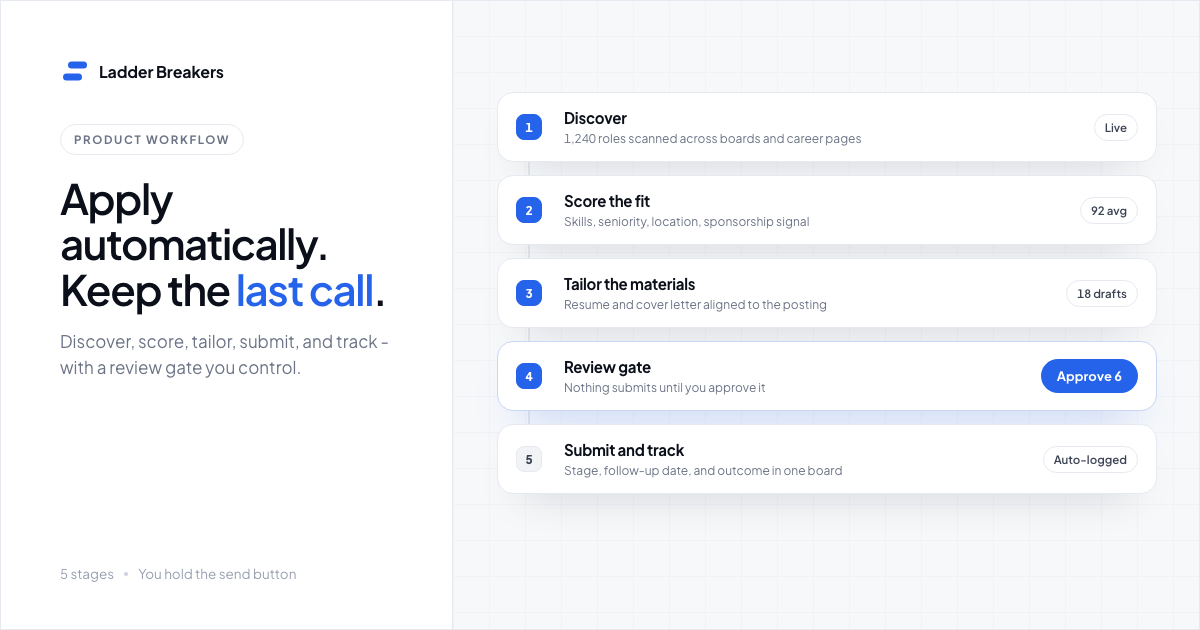
A serious automatic application tool should have match scoring, role freshness checks, tailored resume versions, saved answer consistency, duplicate prevention, application logs, and a way to inspect what happened. Without those controls, the candidate loses trust in the machine at exactly the wrong moment.
The tool should also help keep claims grounded in real experience. AI-generated material should clarify what is already true, not invent new credentials. If a candidate would not be comfortable explaining the application in an interview, the application needs review before it goes out.
When auto-apply helps most
Auto-apply is especially useful when the candidate has a broad but coherent target market: new grads applying across related roles, OPT students managing a clock, laid-off workers rebuilding pipeline, or experienced candidates testing several adjacent titles.
It is less useful when the candidate needs a very narrow, relationship-heavy search where every application requires deep networking first. Even then, automation can help with tracking and lower-touch roles while the candidate handles high-touch outreach.
Where Ladder Breakers fits
Ladder Breakers is designed around high-quality volume. It connects discovery, match evaluation, tailoring, application execution, and tracking so the candidate can create more chances without pretending every job is worth a shot.
That distinction matters. The promise is not "spray everywhere." The promise is "keep the right applications moving while you focus on the human leverage points."
The best test before buying
Ask whether the tool makes your next week clearer. Can you see which roles it will target? Can you control the rules? Can you review outcomes? Can you tell which applications were sent and why? Can you connect application volume to interviews?
If the answer is yes, automation becomes leverage. If the answer is no, it becomes another black box in a search that already has too many of them.
Related Ladder Breakers guides
FAQ
What should I look for in an AI tool that applies to jobs automatically?
Look for fit scoring, preference controls, truthful resume tailoring, duplicate prevention, application logs, source tracking, and the ability to inspect what was sent and why.
Is auto-applying to jobs bad?
Auto-applying is risky when it sends generic or inaccurate applications. It can help when it targets realistic roles, tailors honestly, tracks every submission, and keeps the candidate in control.
Sources and further reading
- Google Search Central: SEO Starter Guide
- Google Search Central: Helpful, reliable, people-first content
- Simplify Copilot
- Teal
- Jobscan Resume Scanner
- Huntr Help Center: What is Huntr?
- Jobright
- LinkedIn Research: Talent 2026
- LinkedIn Skills on the Rise 2026
- NACE Job Outlook 2026 Spring Update
- NACE: Demand for AI Skills in Entry-level Jobs Nearly Triples Since Fall 2025