Quality vs. Quantity in Job Applications: The Answer Is Both
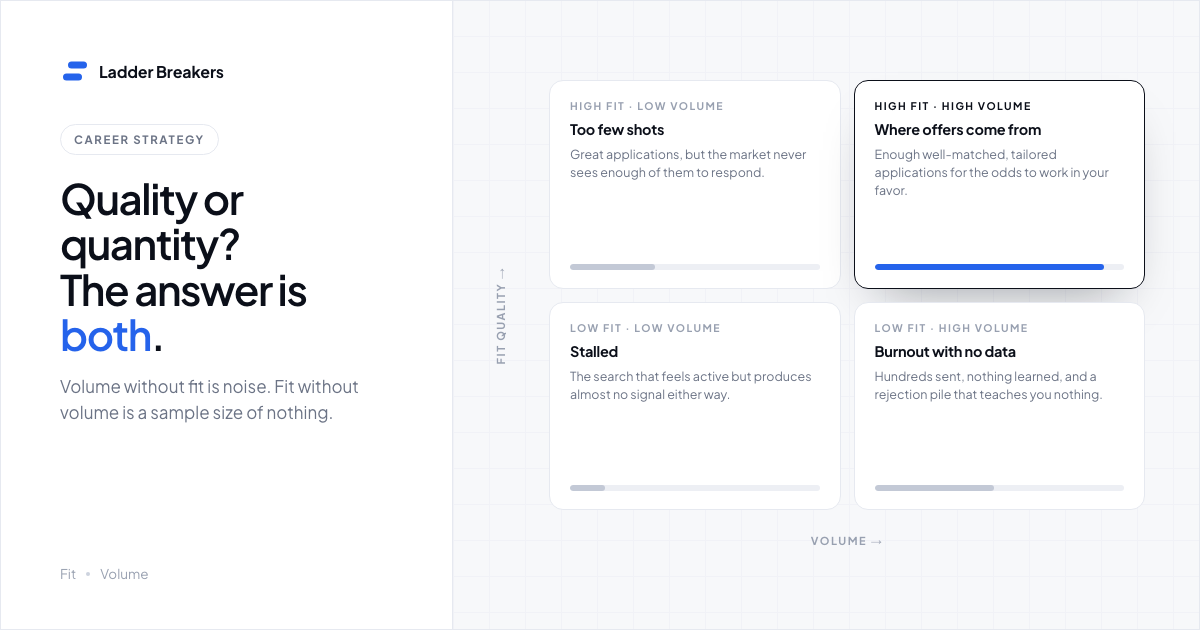
The worst debate in job search is quality versus quantity. You need quality because humans decide. You need quantity because markets are noisy.
Key takeaways
Low-quality volume burns time and morale.
Low-volume perfection leaves too much to luck.
The target is high-quality volume: fit-based, tailored, tracked, and iterated.
Why quantity alone fails
Submitting hundreds of generic applications can feel productive because the number is visible. But if the roles do not fit, the resume does not map to the job, and the answers are generic, the pipeline is mostly noise. Noise is exhausting because it produces activity without evidence of progress.
Quantity without quality also makes learning harder. When everything is random, you cannot tell what worked.
Why quality alone fails
The opposite mistake is perfectionism. Some candidates spend an entire evening on one application, then feel too drained to apply again for days. The application may be excellent, but the market has randomness: stale postings, internal candidates, budget changes, recruiter overload, location filters, sponsorship constraints, and timing.
A few perfect applications cannot absorb that randomness. You need enough attempts for the market to reveal where your profile is resonating.
High-quality volume is the goal
High-quality volume means every application clears a basic fit bar, uses a resume version aligned to the role, answers the application honestly, and gets tracked. It does not mean every application takes an hour. It means the system has standards.
This is the exact place where software should help. Machines are good at repetition. Humans are good at judgment. The workflow should combine both.
A simple application scorecard
Before applying, ask four questions. Does the role match my target title or adjacent title? Can my resume show at least three clear points of evidence? Is the location, work authorization, and level realistic? Can I explain why this company or role makes sense in two sentences?
If the answer is yes, tailor and send. If the answer is no, skip or save for later. Discipline is not only doing more. It is refusing low-signal work.
Track signal, not just submissions
A mature search tracks response rate by title, company type, location, resume version, and source. If backend roles respond and product roles do not, adjust. If referrals outperform cold applications, increase outreach. If one resume version wins more screens, study why.
The goal is not to apply forever. The goal is to learn your way to interviews faster.