How to Find Companies That Sponsor H-1B in 2026
When your status depends on the next offer, every application should begin with sponsor probability, not wishful thinking.
Key takeaways
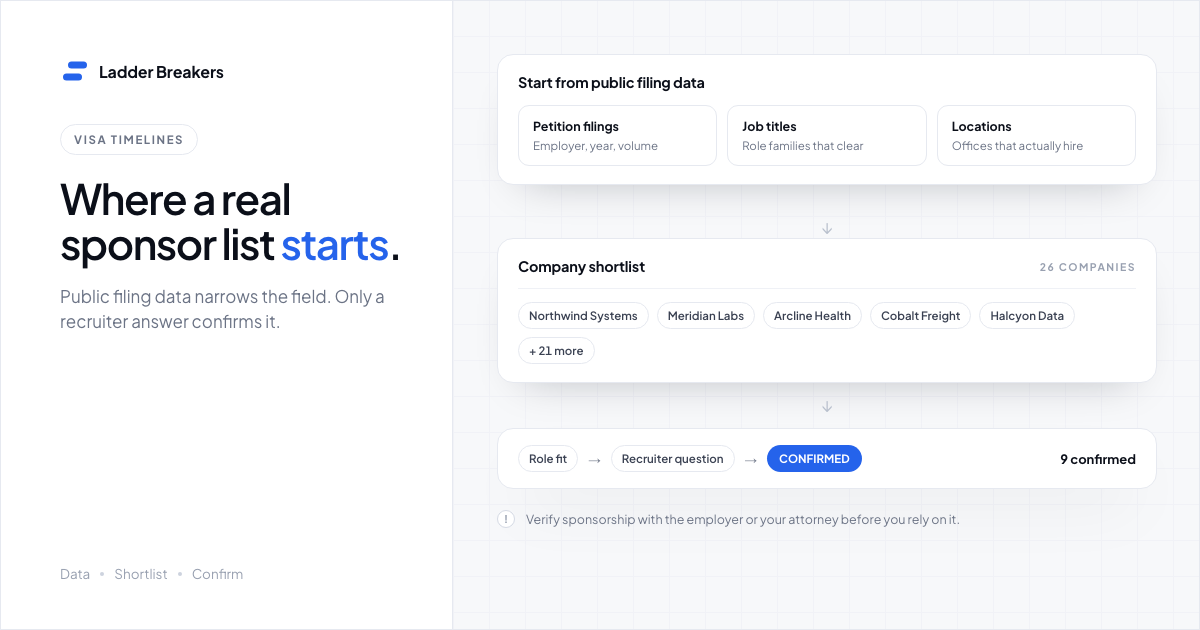
Start with official public data, but understand what each source actually proves.
A company with past H-1B activity is not automatically sponsoring every role today.
The best strategy combines sponsor probability, role fit, freshness, referrals, and fast verification.
Use official data, but read it correctly
USCIS provides immigration and citizenship data, including an H-1B Employer Data Hub for employers petitioning for H-1B workers. The Department of Labor also publishes foreign labor disclosure data, including LCA program data for H-1B, H-1B1, and E-3. These sources are useful because they show real historical activity.
But historical activity is not a promise. A company may have sponsored one team, one location, one level, or one year. Your job is to use the data to build a smarter shortlist, then verify the specific role.
Build a sponsor-probability shortlist
Start with companies that have recent, repeated activity in your role family. Then filter by location, business health, role seniority, and whether the company is hiring for roles close to your background. A sponsor-friendly company is only useful if the role is also a credible match.
For early-career candidates, large employers, established tech companies, consultancies, research-heavy organizations, and some high-growth startups may be more familiar with sponsorship operations. But never assume. Verify.
Read job descriptions for warning signs
Some postings state that the employer cannot provide visa sponsorship now or in the future. Others ask whether you will require sponsorship. Some are silent. Silence does not mean yes. It means you need to ask at the right time.
Also watch for constraints that make sponsorship less likely: short contract roles, very low salary ranges, roles requiring immediate start without transfer support, or companies with no visible history of immigration hiring.
Ask without making sponsorship your whole identity
Your outreach should lead with fit, not status. A strong message says why the role matches your work, includes the job link, and asks whether the team can support the required employment authorization process. Keep it direct and calm.
Example: "I am very interested in this backend role because my recent work maps closely to the distributed systems requirements. Before I proceed too far, can you confirm whether this team can support H-1B transfer or sponsorship for this role?"
Check disqualified employers
The Department of Labor maintains H-1B debarment and disqualification information. This is not the same as a sponsor list, but it is part of responsible screening. If a company appears on a disqualified list, treat that as a serious warning and get professional advice before investing time.
A visa-clock search should protect time. The goal is not more applications everywhere. The goal is more serious conversations with employers who can actually hire you.
Turn the data into a weekly plan
Create a target list of sponsor-probable companies. Apply to fresh roles that match your background. Send referral requests with role links. Track recruiter responses about sponsorship. Remove companies that repeatedly say no. Double down where the signal is good.
Ladder Breakers can help by keeping the application side moving while you use official data and outreach to improve sponsor targeting.
Related Ladder Breakers guides
FAQ
How do I find companies that sponsor H-1B?
Start with official historical data such as USCIS employer data and Department of Labor disclosure data. Then verify the specific role with recruiters or company contacts because past sponsorship does not guarantee sponsorship for every role today.
Does past H-1B sponsorship mean a company will sponsor me?
No. Past sponsorship is a useful signal, not a promise. Sponsorship can vary by role, level, team, location, budget, and timing.
Sources and further reading
- USCIS Immigration and Citizenship Data
- U.S. Department of Labor OFLC Performance Data
- U.S. Department of Labor H-1B Debarred/Disqualified Employers
- USCIS Policy Manual: Practical Training
- USCIS: Options for Nonimmigrant Workers Following Termination of Employment
- Google Search Central: SEO Starter Guide
- Google Search Central: Helpful, reliable, people-first content