The 2026 New Grad Job Search Playbook
The entry-level market is not dead. But the old strategy of applying, waiting, and hoping is not strong enough for 2026.
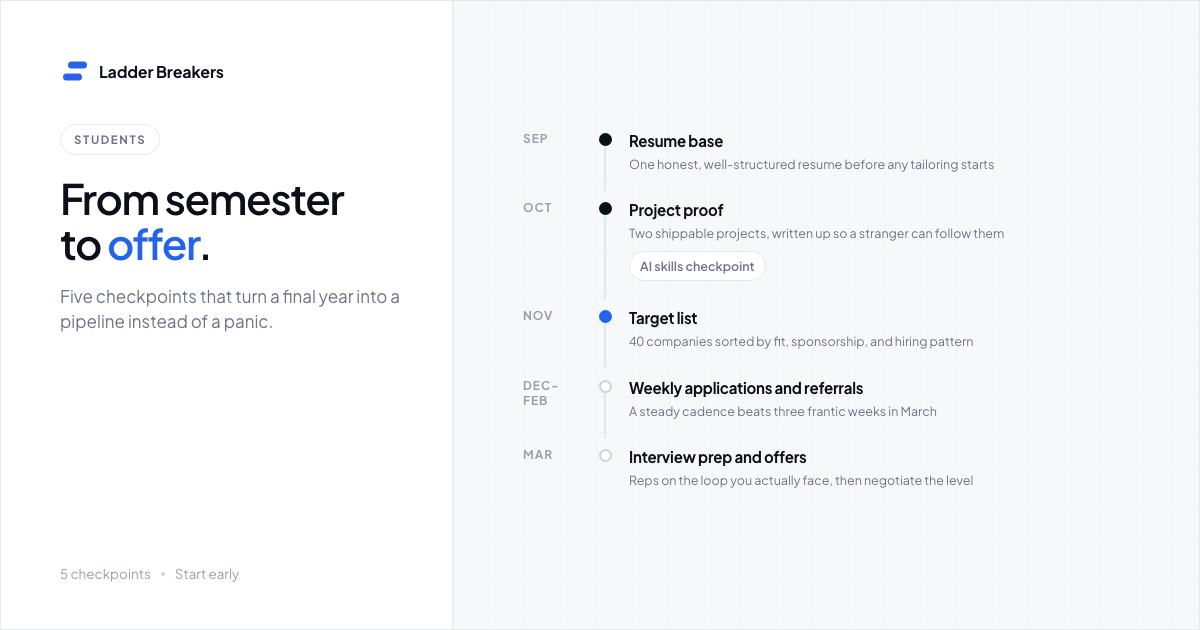
Key takeaways
Class of 2026 hiring is improving in some areas but remains uneven, so students need a structured pipeline.
Employers are emphasizing skills, experiential learning, communication, problem solving, and AI fluency.
New grads should combine targeted applications, proof projects, referrals, interview practice, and weekly metrics.
Understand the 2026 market
NACE reports that Class of 2026 hiring is up in its Spring Update, but the growth is uneven across industries and employer types. Employers also describe the market as fair, not easy. That means new grads should avoid both panic and passivity.
The right response is structure. You need a repeatable system that creates enough opportunities while improving the quality of your profile every week.
Build proof before you need it
Entry-level candidates often have similar coursework, similar internships, and similar resume templates. Proof is what separates you. Proof can be an internship, research, campus work, a shipped project, a volunteer system, open-source contribution, case competition, published analysis, or a technical write-up.
The strongest proof has a visible output. A deployed app. A dashboard. A report. A GitHub repo. A design case study. A customer story. A professor or manager who can validate the work.
Show AI fluency without AI washing
NACE has reported rising employer demand for AI skills in entry-level work. LinkedIn also shows employers shifting toward skills and AI-assisted hiring. New grads should respond by learning practical AI workflows in their field, not by adding vague AI buzzwords.
If you used AI to analyze data, speed up research, prototype code, generate tests, summarize user feedback, or improve operations, explain the workflow and the result. Employers want evidence that you can use tools responsibly.
Create a weekly job-search operating system
A strong week has five lanes: targeted applications, referral outreach, interview practice, profile improvement, and review. Each lane matters. Applications create chances. Referrals add trust. Interview practice converts chances. Profile improvement raises your baseline. Review prevents repeated mistakes.
Do not let one lane consume everything. A student who only applies may never improve conversion. A student who only prepares may never create enough opportunities.
Use role families, not random titles
Pick two or three role families that connect to your proof. For example: data analyst, business analyst, and product operations. Or backend engineer, platform engineer, and developer tools engineer. This gives your search range without making your resume incoherent.
Each role family should have its own resume emphasis, keyword set, project proof, and interview prep plan.
Do the weekly review
Every week, review applications sent, responses, screens, interviews, referrals, titles, locations, and resume versions. Ask what produced signal and what did not. Then adjust the next week.
This turns the search from emotional guessing into controlled iteration. You cannot control the market, but you can control whether your system learns.
Related Ladder Breakers guides
FAQ
When should new grads start applying for 2026 jobs?
Start before graduation pressure peaks. Build proof, role-family resumes, target lists, referral habits, and interview practice early enough that your weekly system is already running when hiring cycles open.
What matters most for new grad job applications?
Role-aligned proof matters most: internships, projects, research, shipped work, measurable outcomes, strong communication, and evidence that you can use modern tools responsibly.
Sources and further reading
- LinkedIn Research: Talent 2026
- LinkedIn Skills on the Rise 2026
- NACE Job Outlook 2026 Spring Update
- NACE: Demand for AI Skills in Entry-level Jobs Nearly Triples Since Fall 2025
- USCIS Policy Manual: Practical Training
- USCIS: Options for Nonimmigrant Workers Following Termination of Employment
- Google Search Central: SEO Starter Guide
- Google Search Central: Helpful, reliable, people-first content