Why You Are Getting Rejected Without Interviews
Most rejections are not proof you are not good enough. They are proof your search system is leaking signal somewhere before a human has a reason to believe in you.
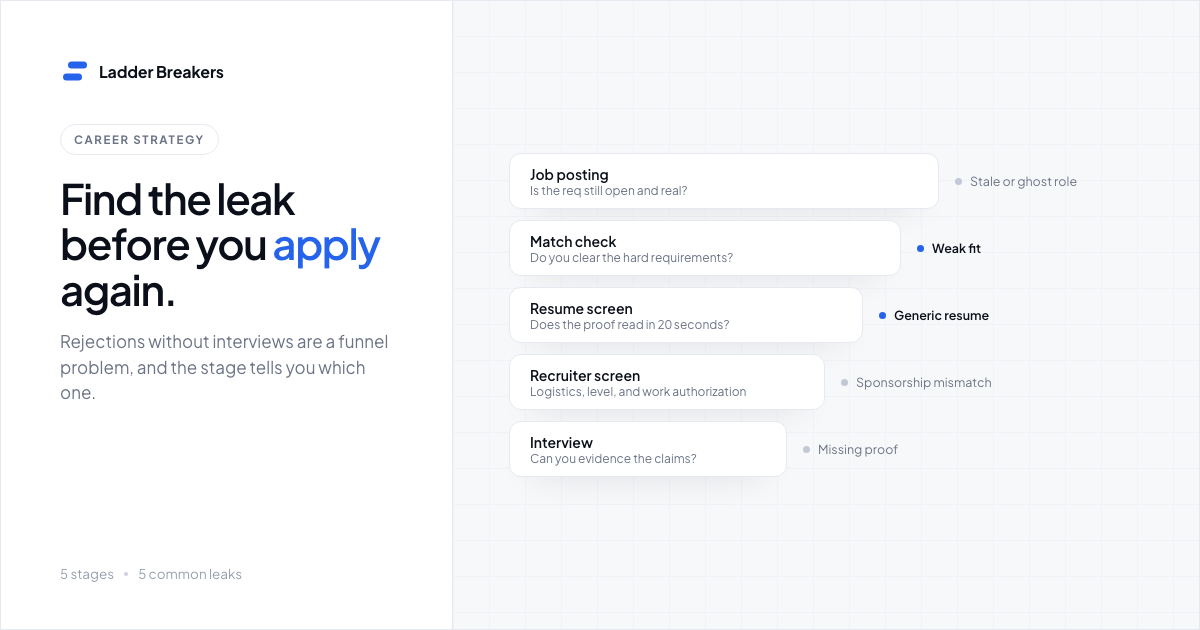
Key takeaways
No-interview rejection usually means the application failed before the conversation stage.
The biggest leaks are weak targeting, generic resumes, stale postings, unclear proof, and hidden constraints like location or sponsorship.
The fix is a feedback system: apply to better-fit roles, tailor faster, track outcomes, and adjust weekly.
Start with the right diagnosis
A rejection without an interview feels personal because it arrives with no explanation. But the hiring process has many filters before a recruiter ever reaches out. A role may already have an internal candidate. The posting may be old. The location may be wrong. The company may not support your authorization path. Your resume may be true but not obvious enough for the role.
The first mindset shift is this: do not treat every rejection as a verdict on your talent. Treat it as a data point about the match between role, timing, resume, and market.
Leak 1: the role was never a strong fit
A common mistake is applying because the title sounds close. Titles are noisy. A product analyst role at one company may be SQL-heavy, while the same title somewhere else may be dashboard maintenance and stakeholder reporting. A software engineer role may be backend, platform, ML, frontend, infra, or full-stack in name only.
Before applying, look for three pieces of evidence you can honestly show. If you cannot map your resume to at least three core requirements, it may still be worth saving, but it should not dominate your pipeline.
Leak 2: the resume is too generic
A generic resume forces the reader to do the matching work. Recruiters and screeners do not have time to infer your fit from scattered clues. If the job asks for customer analytics, your analytics work should be visible. If the role needs distributed systems, the relevant systems work should not be buried under unrelated bullets.
Tailoring does not mean inventing experience. It means changing emphasis. Same truth, sharper angle.
Leak 3: your proof is too soft
Bullets like "worked on," "helped with," and "responsible for" rarely create urgency. Strong proof shows action, scope, and result. It can be a metric, a shipped feature, a user group, a system size, a business outcome, a research result, or a clear technical constraint you solved.
If you are early career and do not have big workplace metrics, use project proof. Show deployment, users, tests, datasets, latency, accuracy, experiments, or real constraints. Proof does not have to be famous. It has to be concrete.
Leak 4: timing is working against you
Many postings are not equal. Some are fresh and actively reviewed. Some are evergreen. Some are paused. Some were created for a candidate the company already knows. If you keep applying late, you may be competing after the shortlist has already formed.
This is why application freshness matters. A job-search system should help you see roles early, prioritize them quickly, and avoid spending premium effort on stale opportunities.
How to fix the pattern
Create a weekly rejection review. Group applications by title, location, company type, source, resume version, and age of posting. Look for signal. If one title never responds, change the title mix. If one resume version gets screens, study it. If referrals outperform cold applications, shift time to outreach.
Ladder Breakers is built for this exact problem: matching, tailoring, applying, and tracking in one loop so you can stop guessing where the search is leaking.
Related Ladder Breakers guides
FAQ
Why am I getting rejected without interviews?
The most common causes are weak role fit, a generic resume, unclear proof, stale postings, location mismatch, level mismatch, or work authorization constraints. Treat the pattern as a system issue to diagnose, not a verdict on your ability.
Should I apply to more jobs if I am getting no interviews?
Only after checking quality. More applications help when they are targeted and tailored. If the roles are weak fits or the resume is generic, increasing volume usually creates more silence.