Best AI Job Application Tools in 2026: What to Use and When
The best AI job search tool is not the one that writes the most words. It is the one that helps a real candidate create more real chances without losing trust.
Key takeaways
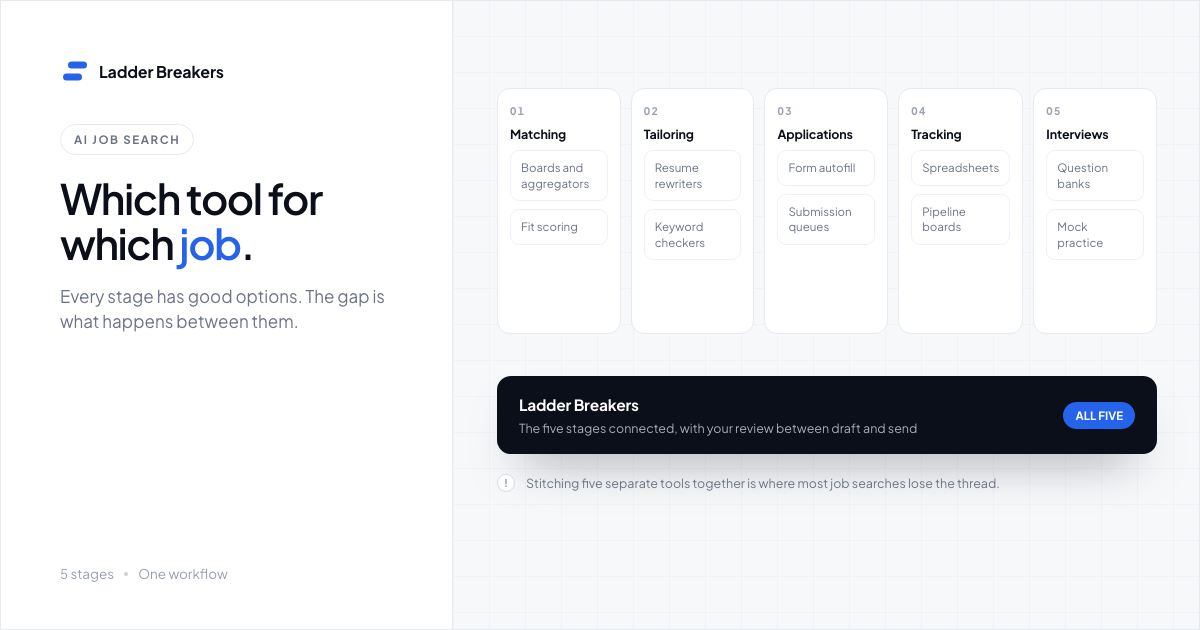
Most AI job search tools solve one part of the workflow: resumes, tracking, autofill, job discovery, or interview prep.
Candidates need a system that combines quality targeting, honest tailoring, consistent output, and review.
Automation helps when it removes admin work. It hurts when it creates generic claims, weak fit, or applications the candidate cannot defend.
Start with the workflow, not the logo
Job seekers often ask which AI tool is best before they define the job the tool has to do. That leads to tool-hopping. One app writes a resume. Another tracks jobs. Another fills forms. Another finds postings. The candidate still has to connect everything while exhausted.
A stronger question is: where is the search leaking? If you are not finding enough fresh roles, you need discovery. If you are applying to realistic roles and getting no interviews, you need targeting and resume alignment. If you are getting interviews but no offers, you need interview practice and story repair. If you are losing track of everything, you need pipeline control.
The main AI job search categories
Resume scanners compare a resume against a job description and point out missing language. They are useful for clarity, but they do not solve job discovery, application execution, or follow-up. Job trackers organize opportunities, but they usually require manual input. Autofill tools reduce repetitive form work, but they do not decide which jobs are worth applying to. AI writers can draft bullets, summaries, and cover letters, but they need strong guardrails.
Full application agents try to connect these steps: find roles, score fit, tailor materials, execute applications, track outcomes, and help the candidate learn from response data. That is the category Ladder Breakers is built for.
Where Ladder Breakers fits
Ladder Breakers is for candidates who need more opportunity creation without turning the search into spam. The product philosophy is high-quality volume: more applications, but only when the role has enough fit, the resume can honestly show that fit, and the candidate can still explain every claim.
That matters for students, laid-off workers, H-1B workers, OPT candidates, and anyone trying to break into competitive roles. They do not just need another text generator. They need a repeatable operating system.
The risks of AI automation
AI can make a weak search worse if it hides the truth. A resume that invents cloud experience may pass a keyword scan and fail in the first technical conversation. A cover letter that sounds polished but says nothing specific wastes time. A mass-application habit can create the feeling of progress while producing no recruiter signal.
Use AI to clarify proof, not manufacture it. The right tool should make your actual experience easier to read, your constraints easier to manage, and your weekly output easier to sustain.
How to choose the right tool
Choose based on your bottleneck. If your resume is unclear, use a tailoring tool. If you have no pipeline, use a tracker or application agent. If you have sponsorship constraints, choose tools that let you prioritize employer fit. If you are applying manually for hours every day, choose automation that still gives you control.
The hopeful truth is that most candidates do not need magic. They need a system that keeps creating the next honest chance, then learns from the market.
Related Ladder Breakers guides
FAQ
What is the best AI job application tool in 2026?
The best tool depends on the bottleneck. Resume scanners help with alignment, trackers help with organization, autofill tools reduce repetitive work, and full application agents like Ladder Breakers connect matching, tailoring, applying, and tracking.
Can AI job application tools hurt my search?
Yes, if they create generic applications, invent experience, or push you toward roles you cannot defend. Used well, AI should clarify your real fit and reduce manual drag.