Why LinkedIn Alone Is Not Enough for Your Job Search
LinkedIn is useful. It is not a job search strategy by itself. A serious search needs discovery, proof, outreach, applications, tracking, and review.
Key takeaways
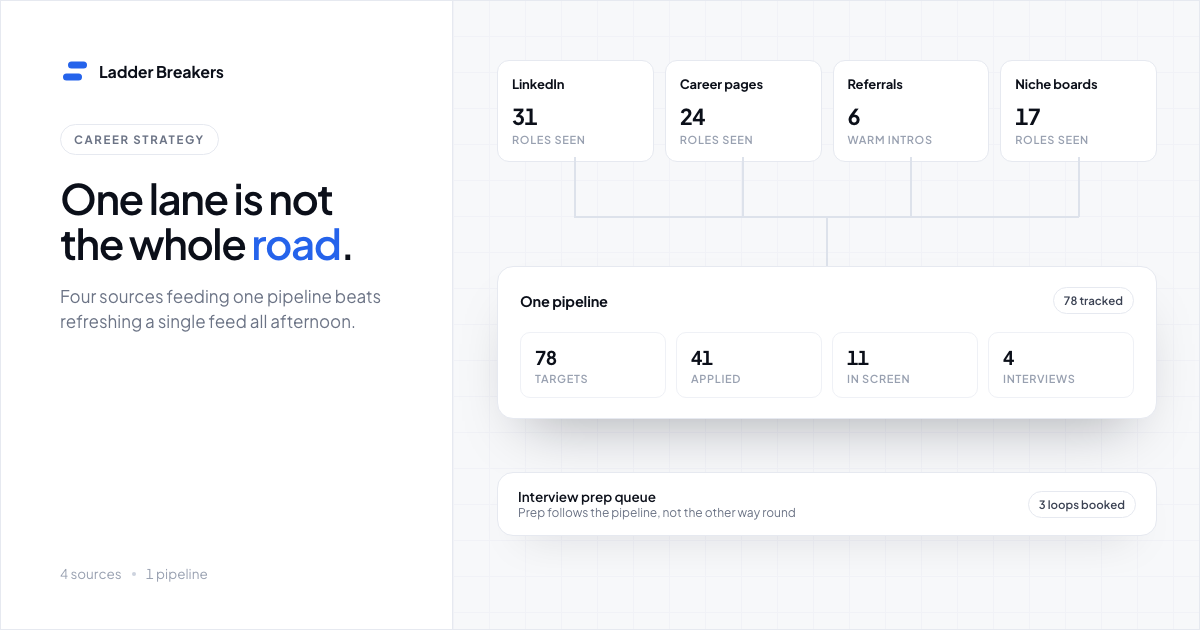
LinkedIn is a valuable channel, but it is crowded and not always the freshest source for every role.
Candidates need multiple channels: company sites, referrals, niche boards, communities, alumni networks, and tracked follow-up.
The goal is a controlled pipeline, not endless scrolling.
LinkedIn is a channel, not the whole market
LinkedIn is one of the most important job search surfaces because recruiters, employees, and candidates all gather there. But every crowded marketplace has noise. Popular roles can attract huge attention quickly, and some postings are duplicated, stale, or too broad.
A candidate who only refreshes LinkedIn may miss jobs on company career pages, niche communities, university boards, venture portfolio pages, Slack groups, Discord communities, alumni newsletters, and recruiter lists.
The platform can reward scrolling
Scrolling feels active because new postings keep appearing. But activity is not the same as pipeline progress. If a two-hour session ends without targeted applications, referral messages, resume improvements, or follow-ups, the search did not move much.
A stronger system converts discovery into action. Every promising role should become a decision: apply, ask for referral, save for later, reject, or research sponsor fit.
Your profile is only one proof surface
A strong LinkedIn profile helps, but recruiters still need job-specific proof. Your resume, portfolio, GitHub, case studies, project demos, referrals, and interview stories all contribute to the decision. If those assets do not align, the profile alone cannot carry the search.
Think of LinkedIn as a storefront. It should invite attention, but the rest of the search has to convert that attention into conversations.
Build a multi-channel weekly plan
A practical weekly plan includes LinkedIn, direct company applications, referral outreach, recruiter follow-up, niche boards, and review. Split your effort by expected signal. If referrals are producing responses, protect time for them. If company pages show fresher roles, check them daily.
Track each source. Over time, you should know which channels produce screens, not just which channels feel busy.
Use LinkedIn better by using it less randomly
LinkedIn works best when it has a job. Use it to identify hiring teams, find second-degree contacts, understand company language, follow recruiters, and validate role demand. Do not let it become the place where your hope gets drained by endless comparison.
The hopeful move is to widen the search while tightening the system. More channels, better choices, cleaner tracking, and a weekly review give you more paths to the same goal.
Related Ladder Breakers guides
FAQ
Is LinkedIn enough for a job search?
LinkedIn is important, but it should not be the only channel. Strong searches also use company career pages, referrals, niche job boards, alumni networks, recruiter outreach, and tracked follow-up.
What should I use besides LinkedIn?
Use direct company sites, portfolio company job boards, university resources, professional communities, targeted referrals, and a job application tracker or application agent.
Sources and further reading
- LinkedIn Research: Talent 2026
- LinkedIn Skills on the Rise 2026
- NACE Job Outlook 2026 Spring Update
- NACE: Demand for AI Skills in Entry-level Jobs Nearly Triples Since Fall 2025
- Google Search Central: SEO Starter Guide
- Google Search Central: Helpful, reliable, people-first content
- World Economic Forum: Future of Jobs Report 2025
- NACE Job Outlook 2025