Job Search Strategy for Laid-Off Tech Workers
A layoff can take your calendar, your confidence, and your routine in one afternoon. The comeback starts by turning the search into a system before panic gets to write the plan.
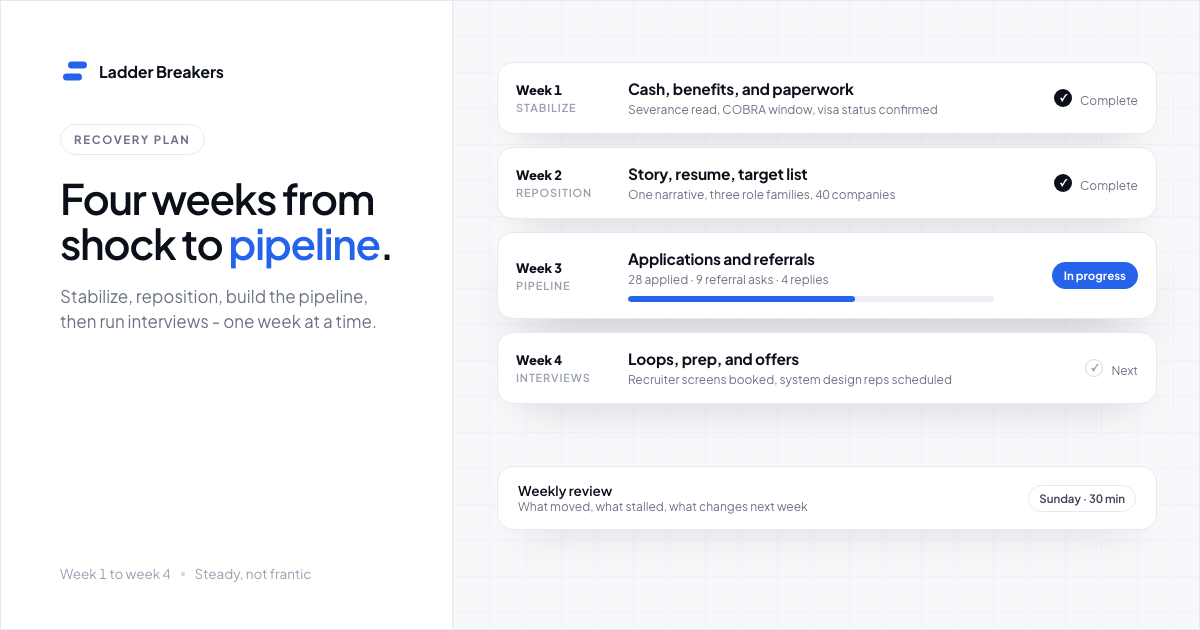
Key takeaways
Laid-off tech workers need emotional stabilization and pipeline rebuilding at the same time.
The best plan separates immediate income risk, positioning, applications, referrals, interview prep, and weekly review.
AI and automation help most when they restore consistency without hiding the candidate's real story.
Start by separating shock from strategy
A layoff is not a performance review, even when it feels like one. Companies cut teams for budgets, strategy shifts, leadership changes, acquisitions, and market pressure. Treat the first few days as stabilization time: documents, finances, benefits, references, portfolio access, and a clean account of what happened.
Then build the job-search system. Panic wants one giant task called "get a job." A system turns it into lanes you can run: positioning, applications, referrals, interview practice, follow-up, and recovery.
Rewrite the story before rewriting the resume
The resume should make your next role obvious. If you were a backend engineer, platform engineer, data analyst, product manager, designer, support engineer, or engineering manager, decide which two or three role families you are targeting now. Do not ask one resume to tell five unrelated stories.
Your layoff explanation can be simple and calm. You do not need to over-explain. Lead with what you built, what you learned, and what kind of team you can help next.
Build pipeline before confidence returns
Confidence often comes after motion, not before it. Create a weekly application target, referral target, follow-up target, and interview practice target. Use a tracker so progress is visible even before responses arrive.
The first goal is not to get every application perfect. The first goal is to rebuild the machine that creates chances. Once the pipeline exists, you can tune quality, messaging, and interview conversion.
Use the market, do not wrestle the market
BLS projects computer and information technology occupations to grow much faster than the average from 2024 to 2034, but that does not mean every segment is easy right now. Some roles are crowded, some teams are cautious, and some openings close fast.
Use that reality strategically. Apply early to fresh postings. Test adjacent titles. Watch which industries are still hiring. Consider contract-to-full-time, smaller companies, and less obvious employers if they fit your goals.
Turn applications into learning
Track source, title, company type, resume version, response, screen, interview, and rejection reason when available. If one title gets traction, feed it. If one resume version is quiet, revise it. If referrals create the most responses, protect outreach time.
Ladder Breakers can help by reducing the repetitive drag of finding, tailoring, applying, and tracking, so the laid-off candidate can spend more energy on interviews, networking, and rebuilding proof.
Related Ladder Breakers guides
FAQ
What should I do first after a tech layoff?
Stabilize first: preserve employment documents, update finances, secure references, save portfolio access where allowed, and write a calm version of your story. Then rebuild the search with target roles, applications, referrals, interview prep, and weekly review.
How do I rebuild confidence after being laid off?
Do not wait for confidence before taking action. Build a visible pipeline of applications, referrals, follow-ups, and interview practice. Confidence often returns after the system starts creating motion again.
Sources and further reading
- World Economic Forum: Future of Jobs Report 2025
- NACE Job Outlook 2025
- LinkedIn Research: Talent 2026
- LinkedIn Skills on the Rise 2026
- NACE Job Outlook 2026 Spring Update
- NACE: Demand for AI Skills in Entry-level Jobs Nearly Triples Since Fall 2025
- Google Search Central: SEO Starter Guide
- Google Search Central: Helpful, reliable, people-first content